Ten Resume Mistakes That Are Killing Your Job Chances
The most common resume mistakes that hurt ATS matching, weaken recruiter first impressions, and cost interviews, plus how to fix them.
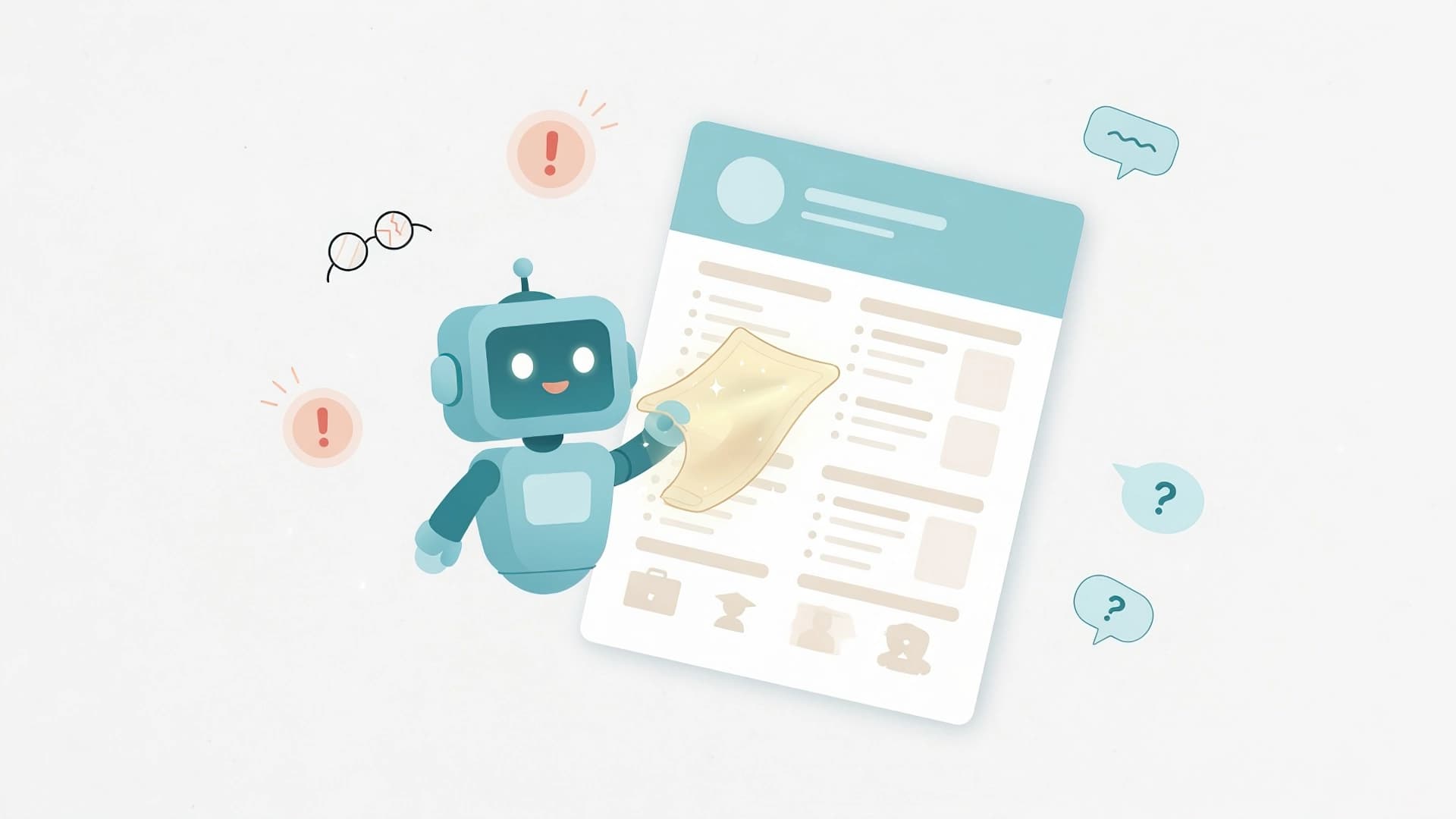
Most resume rejections happen quickly. A resume usually fails because it is hard to parse, hard to scan, weak on relevance, or weak on credibility. The most expensive mistakes are basic ones: vague positioning, weak bullets, cluttered layout, and claims you cannot support.
Why these mistakes matter so early
A resume has to pass two tests. First, it needs to be machine-readable in the applicant tracking system or application form. Then it needs to make sense to a recruiter who is scanning fast for fit, level, and evidence.
The biggest problems are rarely “you are not qualified.” They are “your fit is not obvious fast enough” or “the file makes your experience harder to trust.”
1. Typos and sloppy grammar
A typo looks small, but under time pressure it becomes a shortcut signal for carelessness. If the role involves writing, communication, or attention to detail, the cost is even higher.
2. Generic, untailored content
A resume that could be sent to any employer feels weaker to all of them. If the headline, summary, and top bullets do not reflect the target role, the recruiter has to do extra work to connect your background to the job.
3. Bullets that list duties instead of results
“Responsible for” bullets are rarely strong enough on their own. What differentiates you is what changed because of your work: speed, quality, revenue, accuracy, customer satisfaction, adoption, or delivery reliability.
If you can, rewrite bullets in a structure like: action + scope + method + outcome.
4. A cluttered layout that is hard to scan
Dense text, long paragraphs, weak hierarchy, and too many design elements increase cognitive load. A recruiter should be able to find your role, recent experience, and evidence without searching.
5. ATS-hostile formatting
Tables, text boxes, graphics, multi-column layouts, and contact information hidden in headers or footers can all make parsing less reliable. Even a good resume loses value if the system reads it poorly before a human sees it.
Use standard section names like Summary, Experience, Education, and Skills, keep contact details in the main body of the document, and prefer simple text-based formatting unless the employer explicitly expects something else.
The ATS guide covers the safer formatting defaults in more detail if this is the part you want to fix first.
Strong default rule
If a recruiter only reads the first screen, they should still understand what role you fit, what environment you know, and what kind of results you usually create.
6. A weak or self-focused opening summary
“Seeking a challenging opportunity” does not tell an employer much. A better opening names your role, level, strengths, and the kind of value you bring.
If the top section is where your resume feels weakest, the resume summary guide gives you a stronger structure to work from.
7. Too much length and irrelevant detail
The real issue is not page count alone. It is what page count does to focus. When old, weakly relevant detail gets equal weight with your strongest evidence, the resume becomes harder to read and harder to remember.
8. Missing or poorly evidenced skills
A skills section helps, but only if the skills are current, role-relevant, and also supported in your experience bullets. A skill that appears only as a keyword is weaker than one you prove.
9. Unprofessional or inconsistent personal branding
A weak email address, inconsistent titles across resume and LinkedIn, or confusing contact details can make an otherwise good profile feel less polished and less trustworthy.
10. Exaggeration, dishonesty, or unexplained credibility gaps
Inflated titles, guessed metrics, fake tools, and evasive career gaps create trust problems fast. If a line sounds strong but cannot survive follow-up questions, it is not helping you.
How to pressure-test your final version
- Is the target role obvious in the top section?
- Do your strongest bullets show outcomes, not just duties?
- Is the layout easy to scan in one column?
- Would every claim survive an interview follow-up?
- Does the file stay readable in plain text and simple formatting?
If you want a structured review before applying, start with the resume analyzer, then tighten the wording with the experience bullet guide and the keyword playbook.
That is also where CVoria is most useful: as a last pass that surfaces weak evidence, fuzzy positioning, and avoidable formatting problems before the application leaves your hands.
FAQ: common resume mistakes
What is the single most damaging resume mistake?
Usually a generic resume with no clear top-of-page match. It wastes the most valuable space and weakens both ATS matching and human first impressions.
Are two pages always too long?
No. Two pages can be completely reasonable. The real question is whether both pages help the target application or whether the second page mostly adds noise.
Do ATS systems reject creative formatting?
Not always, but simple formatting is safer. If key information is stored in graphics, tables, headers, or unusual layouts, parsing becomes less reliable.